Tuesday, February 7, 2012

Melville and Whitman


UPDATE: another, earlier reprinting from the New York Citizen appeared in the Cincinnati Commercial for July 25, 1871.
Cincinnati Commercial - July 25, 1871
A rare linking of the two in the American press. Nice to have in advance of the Ninth International Melville Conference ("Melville and Whitman in Washington"), scheduled for June 17-20, 2013 in Washington, D.C.

The poetry of animal existence!

From the Albany Evening Journal for August 11, 1871; found in the archives of genealogybank.com:
“WHAT has become of Herman Melville?” asks the New York Citizen.  “Years ago—say twenty, or thereabouts—he wrote a series of novels, which, for unique merit and outrageous faults, have had few equals.  Then he suddenly relapsed into silence, broken only by a volume of strikingly original, if extremely bad, poetry.  At the present day no one hears his name:  and yet, with the single exception of Walt Whitman, America has produced no writer so fresh, bold, vigorous, and genuinely poetical, as Herman Melville.  For no one can carefully read Melville’s novels, with the exception, perhaps, of “Typee,” without perceiving the wonderful resemblance which the author bears, in his method of work, to Walt. Whitman.  They are both poets, who cannot write in rhyme or in obedience to the laws of prosody.  They both celebrate the glory of physical manhood, the poetry of animal existence.  Each is rude in utterance, involved and affected in diction, but rhythmic and sonorous in spite of a defiance of prosody and rhetoric.”

Monday, January 30, 2012

Scoresby's crow's nest, Melvillized

Still looking at Melville's rewrite of Scoresby in chapter 35 of Moby-Dick.  After finding another example there of Melville's use of "owing to" when revising a source, I thought it would be fun to compare more of Scoresby and Melville, setting the original and rewrite side by side.  Here goes then...

Source:  
William Scoresby, An Account of the Arctic Regions vol. 2 (Edingurgh and London, 1820), 304-205.

Melville's rewrite of Scoresby shown below within brackets, in bold blue from
Herman Melville, Moby-Dick (1851), chapter 35.
... A piece of canvas tied round the head of the main-top-mast, and heel of the top-gallant-mast, extending only from the cap to the cross trees, or at best a canvas stretched round the base of the top-gallant rigging, but open on the after part, was the most complete contrivance of a crow's nest, until a few years ago, when my Father invented an apparatus, having the appearance of a rostrum, [enviable little tents or pulpits, called crow's-nests] which afforded an admirable defence against the wind....The form is cylindrical; open above and close below.  [In shape, the Sleet's crow's-nest is something like a large tierce or pipe; it is open above, however, where it is furnished with a movable sidescreen to keep to windward of your head in a hard gale.] ...The entrance is by a trap-hatch at the bottom. It is fixed on the very summit of the main-top-gallant mast, from whence the prospect on every side is unimpeded. [Being fixed on the summit of the mast, you ascend into it through a little trap-hatch in the bottom.] On the after side is a seat, with a place beneath for a flag. In other parts are receptacles for a speaking trumpet, telescope, and occasionally for a rifle piece*, with utensils for loading. [On the after side, or side next the stern of the ship, is a comfortable seat, with a locker underneath for umbrellas, comforters, and coats. In front is a leather rack, in which to keep your speaking trumpet, pipe, telescope, and other nautical conveniences.]  For the more effectual shelter of the observer, when in an erect posture, a moveable screen is applied to the top on the windward side, which increases the height so much as effectually to shield his head. [paraphrased already, above, "where it is furnished with a movable sidescreen to keep to windward of your head in a hard gale."]  When the ship is tacked, nothing more is necessary for retaining the complete shelter, than shifting the screen to the opposite side, which is done in an instant.

*[Scoresby's footnote:] The rifle has been occasionally used for shooting narwhales: when fired at from the deck, it is almost impossible to kill them, partly on account of the resistance of the water, which the ball must pass through, and partly on account of the deception in their position, produced by the refractive property of the water. Shooting from the mast head nearly perpendicularly downwards, in a great measure obviates both these inconveniences.  [rewritten by Melville as follows:  "When Captain Sleet in person stood his mast-head in this crow's-nest of his, he tells us that he always had a rifle with him (also fixed in the rack), together with a powder flask and shot, for the purpose of popping off the stray narwhales, or vagrant sea unicorns infesting those waters; for you cannot successfully shoot at them from the deck owing to the resistance of the water, but to shoot down upon them is a very different thing."]

nuts and bolts of rewriting from sources: "owing to"


Some years back I began to scrutinize Melville's mechanics of revision. One thing I noticed was how much Melville liked to use "owing to" when rewriting his sources.  He evidently favored this device especially for explaining causes and supplying missing information.  Significantly, owing to occurs repeatedly in works where Melville is borrowing heavily from known sources, at least 13x in "Benito Cereno" and 17x in Israel Potter.

So, having taken the trouble to document some uses of owing to in my 2006 conference paper on traces of Melville in "Scenes Beyond the Western Border," I got a kick out of predicting then confirming another one in chapter 35 of Moby-Dick.  Easily amused, that's me alright.

Ishmael's comic take, or take-off, on the crow's nest of Captain Sleet is based on a passage in vol. 2 of William Scoresby's Account of the Arctic Regions.  Melville's debt to Scoresby for the comic bit on Sleet's crow's nest was first demonstrated by Frederick B. Adams, Jr., in Colophon (Autumn 1936).  In The Trying-Out of Moby-Dick Howard Vincent (citing Adams) comments:
Melville pounced upon Scoresby's long, prideful account, parodying its pedantry as well as its piety, its over-particularity.  Even without knowledge of the parody, one enjoys the mockery of Melville's paragraphs, but an awareness of the parodic intent, hidden to all but the source hunter or the student of whaling, enhances one's relish of the humor.  (159)
Now I did not have the Colophon article by Adams, but reading the above in Vincent prompted me to look closer at the text of Melville's parody in Moby-Dick.  Looking then in at Melville's re-write of Scoresby in chapter 35 I encountered that phrase again:
When Captain Sleet in person stood his mast-head in this crow's-nest of his, he tells us that he always had a rifle with him (also fixed in the rack), together with a powder flask and shot, for the purpose of popping off the stray narwhales, or vagrant sea unicorns infesting those waters; for you cannot successfully shoot at them from the deck owing to the resistance of the water, but to shoot down upon them is a very different thing.  (Classic Reader)
Mind you, it was only because of my earlier investigations that I even noticed "owing to."  I had not yet looked up the original source for the passage in Scoresby.  But seeing "owing to" again and recognizing it as a favorite device, I had a strong hunch it was Melville's contribution.  Next step, find the source in Scoresby, which I did at Google Books.

And (drum roll please).... Voila!  Here it is, in a footnote:
 The rifle has been occasionally used for shooting narwhales: when fired at from the deck, it is almost impossible to kill them, partly on account of the resistance of the water, which the ball must pass through, and partly on account of the deception in their position, produced by the refractive property of the water. Shooting from the mast head nearly perpendicularly downwards, in a great measure obviates both these inconveniences.  (Scoresby, Account of the Arctic Regions, vol. 2, p205)
 Yep, owing to is all Melville's doing. Melville likes "owing to" so much he has to change Scoresby's perfectly fine "on account of," while keeping "the resistance of the water."  Cool, huh?

Also Melville's (while we're at it) are
popping off (instead of tedious "shooting")
and
the stray in "stray narwhales"

UPDATE:
more additions by to his source in Scoresby, along with "vagrant sea unicorns" for narwhales:

"infesting"
and
"a very different thing"

And for more on Scoresby, check out the Melvilliana post on Scoresby's crow's nest Melvillized

Friday, January 13, 2012

Divine Hafiz

"What could Pierre write of his own on Love or any thing else, that would surpass what divine Hafiz wrote so many long centuries ago?" --Pierre; Or, The Ambiguities

Hither bring the wine, boy! hither bring the wine, boy!
For the season approaches, the season of joy.
Let us frolic and revel 'midst gardens and bowers,
Since the roses now bud, and the season is ours.
Let the vows of repentance religion has made,
Be forgotten, and broken beneath the cool shade:
Let us warble, like nightingales, through the gay grove,
And, imbedded in roses, here nestle in love.
Come, replenish, replenish the goblet with wine,
For of happiness lo! the sweet rose is the sign:
While she ripens and blows, your enjoyments pursue,
For anon she will wither and bid us adieu.
To the shade then where roses embowering twine,
Come, repair, quick repair, with thy friend, and with wine;
Let oblivious enjoyment there banish distress,
Whilst we warble, like nightingales, 'midst the recess.

'Tis from HAFIZ the rose claims her tribute of praise,
Let him prostrate before her his soul in soft lays,
Let him bow down his head to the dust at her shrine,
And in strains like the nightingale's hail her divine.

--verse paraphrase by John Haddon Hindley in Persian Lyrics (London, 1800)


Friday, January 6, 2012

"Pity's Tear," not by Melville

Warren F. Broderick found five poems signed "H" in the Democratic Press and Lansingburgh Advertiser, published by that newspaper in 1838 and 1839. Broderick's article announcing the discovery ("Melville's First Five Poems?," Extracts 92, March 1993) is available in the online archives of Melville Society Extracts. Since Herman Melville did publish two "Fragments from a Writing Desk" sketches in the Democratic Press in 1839, it has seemed reasonable to conjecture that H. Melville may have submitted these "H" poems to his hometown newspaper.


But the first of the five "H" poems, "Pity's Tear," is definitely not by Melville. A search in Google Books reveals the rightful author as Mary Darby Robinson (1758-1800). Robinson's poem Pity's Tear shows up in volume two of The Poetical Works of the Late Mrs. Mary Robinson, 3 vols. (London, 1806) at 254-255. Lansingburgh's "H" could have found Robinson's poem reprinted in the posthumous London collection, or in an American newspaper or literary magazine, for example The Rural Visiter vol. 1 (Burlington, New Jersey) where "Pity's Tear" appeared without attribution in the August 13, 1811 issue.

Update 07/20/2018: "Pity's Tear" appears over the signature of "Sappho" in The Lady's Monthly Museum for September 1801.

Sunday, November 13, 2011

barbarous involation of a transcendental allegory


After further review the word involation looks like a typo or alternate spelling for involution, meaning the "action of involving or enfolding" and "state of being entangled" according to Webster's Complete Dictionary (New York: Harper & Brothers, 1846).

Another find at genealogybank.com which has a good run of the Picayune, with plenty of "New York Correspondence" from "R" and others. Mardi is a great book that will get some respect, one of these days. And we love "R" anyhow for saying "I know not his equal in English literature" after three two-and-a-half books.

The Daily Picayune (New Orleans, LA) August 18, 1849
From the New Orleans Daily Picayune, August 18, 1849
New York Correspondence.
[SPECIAL CORRESPONDENCE OF THE PICAYUNE.]
NEW YORK, August 7, 1849.
… I am glad to see the announcement of a new work in press by the Harpers, of the brilliant but erratic Herman Melville. It is entitled “Redburn, or the Sailor-Boy—Confessions and Reminiscences of a Gentleman’s Son.” Melville is at home on the deck of a vessel, and can tell as good a forecastle story as any tar that ever handled a marlin-spike. He made a blunder in “Mardi,” by winding up his jovial and flashing pictures of the sea in the barbarous involation of a transcendental allegory, in which all truth was intended to be shadowed forth on poetry, philosophy, politics, religion, love, literature, good eating, and what not; but he broke down dead before he got half through the work, and every reader I know of who has tried to finish it, has shared the same fate. But let Melville “fling away ambition” and content himself with spinning a regular yarn, I declare, I know not his equal in English literature. His “Typee” set half the young men in New York and Boston mad after the peerless vision of his Eve-like Fayaway, and if it had not been for the fear of being eaten alive, they would have gone off in a body to the spicy Eden groves of Nukaheva. “Rudburn,” [sic] I think, will beat “Typee,” as reality is often better than romance.

R.

Tuesday, November 8, 2011

Matthew Henry Buckham, a.k.a. "Maherbal"

M. H. Buckham
from The National Cyclopaedia of American Biography
Thanks to the thrilling finish of the first volume (1819-1851) of Hershel Parker's two-volume biography, Melville fans know "Maherbal" as the Berkshire correspondent of the Vermont Journal who reported Melville's curiously formal dinner engagement with Nathaniel Hawthorne in the dining room of a Lenox hotel. From Lenox on January 10, 1852, "Maherbal" wrote to the Windsor, Vermont newspaper:
Not very long ago, the author of the "Scarlet Letter" and the author of "Typee," having, in some unaccountable way, gotten a mutual desire to see one another, as if neither had a home to which he could invite the other, made arrangements in a very formal manner to dine together at a hotel in this village. What a solemn time they must have had, those mighty conjurors in the domain of the imagination, all alone in the dining-room of a hotel!
Richard E. Winslow III found this and other letters from "Maherbal" in microfilm archives of the Vermont Journal. At his blog Fragments from a Writing Desk, Parker recounts years of searching that led to Winslow's exciting discovery. In the same post Parker explains the evidence, chronology, and reasoning behind his depiction of the hotel scene in Volume 1 as the November 1851 "publication party" at which Melville must have presented a copy of his new book Moby-Dick to his "solitary guest," the dedicatee.

"Maherbal" wrote more of Melville in that January 1852 letter, about his reputation for "exclusiveness" in Pittsfield, about the rough treatment Melville received from unruly students in his early career as a schoolteacher. "Maherbal" wrote too of G.P.R. James and other famous Berkshire residents. In one of his earlier letters from Lenox (dated November 29, 1851), "Maherbal" had focused on Hawthorne, giving colorful details and commentary on Hawthorne's physical appearance and notoriously reclusive lifestyle.

So the other day I was playing around in the newspaper archives at genealogybank.com.

Searching for "maherbal" (and maybe "maherbal + vermont") I found three "Letters from England" in the Vermont Journal (September-October 1855), submitted by their old Lenox correspondent "Maherbal," who was now writing from London. No mention of Melville, but another hit for "maherbal" turned up another article in the Vermont Journal from May 25, 1855--not a "Maherbal" letter at all, but an editorial on "America and the Russian War."

In "American and the Russian War" the editor of the Vermont Journal replies to criticism of American newspapers by "Griffith," a foreign correspondent of another Vermont paper, the Burlington Free Press. At the end of the article the Journal editor unmasks (in a friendly way, I take it) this complaining "Griffith":
... Our readers will be interested to know that the correspondent of the Free Press is none other than "MAHERBAL," whose letters in THE JOURNAL from Berkshire county, Mass., a year or two since, attracted so much interest; and the friends of MR. MATTHEW H. BUCKHAM, formerly of Chelsea, and more recently a tutor in the University of Vermont, and may be gratified to learn that he is both "GRIFFITH" and "MAHERBAL." -- Vermont Journal, May 25, 1855
Also accessible via Newspapers.com:
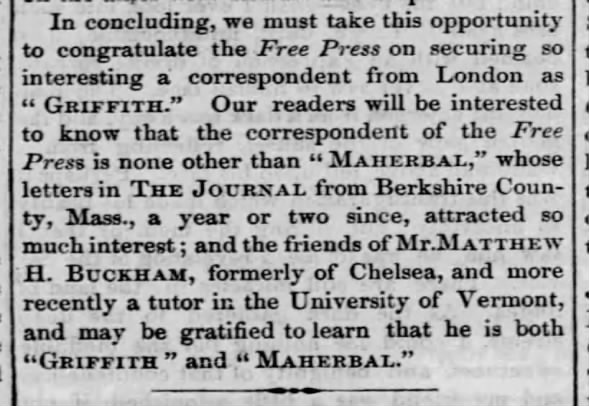
Fri, May 25, 1855 – 2 · Vermont Journal (Windsor, Vermont) · Newspapers.com

Aha! "Maherbal" = Matthew Henry Buckham (1832-1910)
Matthew Henry BUCKHAM, of Burlington [Chittenden County, Vermont], was born 04 July 1832 at Hinckley, Leicestershire, England, son of Rev. James BUCKHAM. He pursued his preparatory studies in the academy at Ellington [Tolland County], Connecticut, and also at a private school in Canada. Entering the University of Vermont in September 1847, he graduated from it in August 1851. He was principal of the Lenox Academy at Lenox [Berkshire County], Massachusetts, from 1851 to 1853. In September 1853 he became tutor of languages in the University of Vermont. In August 1854 he sailed for Europe, spent two years there in travel and study, and returned in 1856 to enter upon a professorship in the University of Vermont. He occupied the chair of Greek in that institution from 1856 to 1871, and also performed the duties of professor of English literature from 1865 to 1871.  --  Men of Vermont
Pittsfield Culturist and Gazette - October 1, 1851
via GenealogyBank
Buckham was nineteen and just out of college when he became principal of the Lenox Academy and began sending letters from Lenox to the Windsor, Vermont newspaper. The Bibliography of Vermont credits Buckham as "one of the authors of a 12mo. volume of about 200 pages, relating to Berkshire County, Mass., published in 1852 or 1853." That would be Taghconic (1852), wherein putative author "Godfey Greylock" (real name Joseph Edward Adams Smith) credits "Mr. BUCKHAM, of Lenox" with two chapters:
10 Lenox and its Scenery
11 Lenox as a Jungle for Literary Lions
Sure enough, chapter 11 of Taghconic contains most of Maherbal's letter dated November 29, 1851 and published in the Vermont Journal on December 12, 1851. The following passage from Taghconic is nearly verbatim from the Journal, but with some interesting changes. For example, where the book version critiques Hawthorne's "unsympathising, morbid spirit," the original letter from "Maherbal" called it "a sort of dreamy, unsympathizing spirit." From Taghconic, chapter 11, by "Mr. Buckham, of Lenox":
Mr. Hawthorne, even for a man of letters, leads a remarkably secluded life. He has a few literary friends with whom he cherishes an intimacy congenial to a mind of such cultivation and sensibility, and a friendship which does honor to his heart, but he shows no disposition to mingle largely in society. This aversion to social intercourse has been remarkable in him during his literary career, and even far back into his youth, if we may credit the accounts of his acquaintances. Not only in his private life, but all through his writings, there seems to breathe an unsympathising, morbid spirit, — a spirit that seems to take a satisfaction in keeping itself aloof from those who are guilty of the foibles which it takes a still greater satisfaction in contemplating. This spirit he could never have inherited from his ancestors, else those progenitors of his, who for so many generations " followed the sea," were a strange set of tars! Perhaps all his better sympathies were chilled in those speculations with his dreamy brethren of the Brook Farm Community; perhaps he and Emerson, enraptured with the mystic perfection of their own fantasies, abjured all communion with this our gross humanity; he certainly could not have had his feelings frozen into hate by contact with the genial and sympathizing intellect of Ellery Channing, or at the warm hearth-stone of Longfellow.
From the letter of "Maherbal" dated November 29, 1851 on "Nathaniel Hawthorne," published in the Vermont Journal on December 12, 1851:
Mr. Hawthorne, even for a man of letters, leads a remarkably secluded life.  He has, doubtless, a few literary friends, with whom he cherishes a friendship congenial to a mind of such cultivation and sensibility, but he shows no disposition to mingle in the highly intellectual society of our village, and even studiously declines any advances which are made towards a familiarity with him on the part of those whose acquaintance he might find ample reason to prize.  This aversion to society has been so remarkable in him during his literary career, at least, and even far back into his youth, if we may credit the accounts of his acquaintances, that it seems to be constitutional with him.  At any rate, a sort of dreamy, unsympathizing spirit, seems to breathe through all his writings, and to manifest itself in various acts of his life, as far back as we have any means of tracing it.  We are sure he could not have inherited it from his ancestors, or else those progenitors of his, who for so many generations “followed the sea,” were a strange set of tars!  Perhaps all his better sympathies were chilled in those speculations with this dreamy brethren of the Brook Farm community—perhaps he and Emerson, in their rapt fantasies, abjured all communion with their fellows of this our gross humanity; he certainly could not have had his feelings frozen into hate by contact with the genial and sympathizing intellect of Ellery Channing, or the warm hearthstone of Longfellow.
Possibly more of Mr. Buckham's letters from Lenox in 1851-1853 will be discovered, either in the Vermont Journal or another Vermont newspaper. As we now know, in 1855 Buckham wrote to the Burlington Free Press under the name "Griffith." It remains to be seen whether the Free Press ever published any communications from a Griffith, or even Maherbal, during Matthew Henry Buckham's tenure as principal of the Lenox Academy.


Bios

  • Prentiss Cutler Dodge, Encyclopedia, Vermont Biography (Burlington, 1912) pages 132-133.
    https://books.google.com/books?id=tt2_3hTQxFMC&pg=PA132&dq#v=onepage&q&f=false